Caller ID shows who is calling before you answer. The mobile network sends the caller's number with the call, and your phone shows a name only if that number is saved in your contacts. Every other call arrives as digits. A caller ID app like Me puts a name on unknown numbers and warns you about spam.
Me is a free caller ID app for iPhone and Android, made by NFO Ltd and identifying calls since 2014. It is free, and it stays free. This guide explains what caller ID is, what your phone can and cannot do on its own, and what changes when you add Me. Get Me for free.
What is caller ID?
Caller ID is the part of a phone call that tells you who is on the other end before you pick up. In the phone industry it is called calling line identification. It covers two different things: the number, which the network delivers with almost every call, and the name, which has to come from somewhere else.
When people talk about caller ID today, they usually mean the second part: seeing a real name on the screen instead of a row of digits.
How does caller ID work?
Step 1: the network sends the number
When someone calls you, their mobile network passes their number along with the call. It travels through every network in between and reaches your phone as it starts to ring. If the caller chooses to withhold their number, the call arrives without it, and your phone shows "No Caller ID", "Private" or "Unknown".
Step 2: your phone looks for a name
Your phone compares the number with your contacts. If it finds a match, it shows the name you saved. If not, the number is all you get. On most phones, that is the whole of the built-in caller ID: it can only name people you already know.
Step 3: a caller ID app fills the gap
A caller ID app adds a third step. While the phone rings, it checks the unknown number against its own directory and shows the name on the call screen, with a warning if the number is known for spam. On iPhone, the name appears inside Apple's own call screen. On Android, the app shows its own caller ID screen.

Why do unknown numbers show only digits?
In most countries the network carries the caller's number, not their name. Some carriers offer a caller name service in a few countries, often as a paid extra, and it does not reach every call. Your phone cannot show a name it was never given, so a new colleague, a delivery driver, your clinic and a spam caller all look the same: a number.
Numbers can also be faked, a practice called spoofing. Some networks now check that a calling number is genuine (in the US and Canada the standard is called STIR/SHAKEN). A check like that confirms the number. It does not tell you who is behind it. That is what a name and a spam warning are for.
How does a caller ID app know the name?
Me's identification comes from the Me community and from spam reports that are updated around the clock. When an unknown number rings, Me shows the name it is known by, the way other Me users chose to save it, and a spam warning when people have reported it.
Me also watches for the behaviour of spam operations, which tend to buy fresh numbers in bulk. A new number that behaves like one can be marked Suspected Spam before anyone has reported it.
What you see when the phone rings
- The caller's name, before you answer.
- A red warning when the number has been reported as spam, with comments from other users.
- Their photo, when they have one.
- Quick actions on Android: message them on WhatsApp, send a text, or save the number.

Caller ID on iPhone
An iPhone names only the numbers in your contacts. From iOS 18.2, Me adds names to unknown numbers through Apple's Live Caller ID: the name appears on the normal iPhone call screen while the phone rings, and identified numbers show up in Recents next to your contacts.
To turn it on, open Settings › Apps › Phone › Call Blocking & Identification and switch on Me. It takes less than a minute.
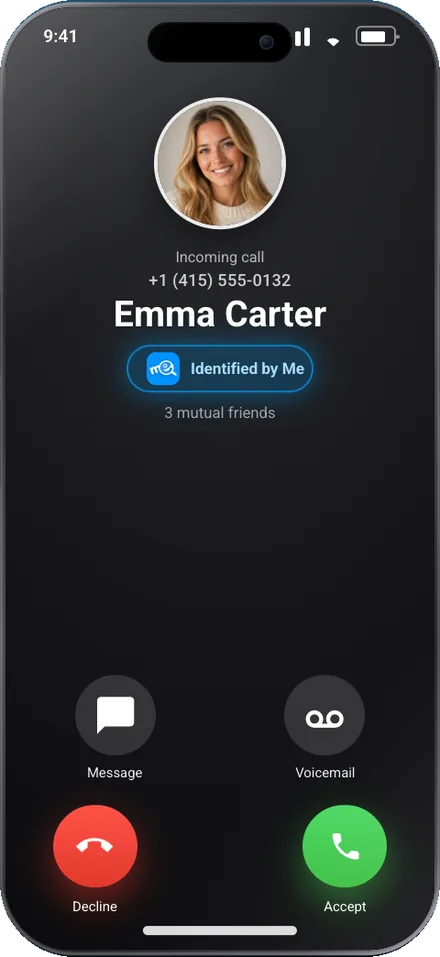

The lookup is private by design. The number is encrypted on your iPhone before it leaves, Me's server works only on encrypted data, and only your iPhone can read the answer. The server never sees which number called you.
For a number you already have, from a message, an email or a missed call, ask Siri, double-tap the back of the iPhone, or press the Action button on models that have one, and Me tells you who it is. Me also filters spam SMS and MMS into a separate folder. With CarPlay, the identified name appears on the car's screen too.
Caller ID for iPhone: the full setup, step by step
Caller ID on Android
Android has no built-in caller ID for numbers outside your contacts. The phone app on some Android phones flags a few spam numbers, but it cannot put a name on an ordinary unknown number. Me works on Android 7.0 and later. It needs two permissions, contacts and call log, because without them there is nothing to compare an incoming number with. Making Me your default phone app is optional.
Caller ID modes: full screen, popup or compact
Me can show an incoming call in three caller ID modes:
- Full screen caller ID. The whole call screen belongs to Me: the caller's name, their photo when there is one, and one-tap actions. It shows the most, and it is hard to miss.
- Expanded popup. A card that floats over whatever app you are using. Drag it anywhere on the screen.
- Compact popup. The same idea in one small strip, for when you only want to know whether to answer.

To switch, open Me's caller ID settings and choose the display you want. The new mode applies from the next call. In full screen mode you also pick how to answer: Me offers four answer styles. The modes are part of Me on Android; setting the app up on your phone, permission by permission, is covered in Caller ID for Android.
The call bubble
During a call, tap X on the popup to shrink it to a small bubble and keep using your phone. Drag the bubble anywhere on the screen, or tap it to open caller ID again. With Me Pro, caller ID moves to the bubble on its own as soon as you answer.
Caller ID settings
In Me's caller ID settings you decide when caller ID appears and how it behaves: which calls get it, whether Me announces the caller's name out loud, and whether the flash blinks on an incoming call.
If caller ID stops appearing, open Me › Settings › Caller ID Troubleshooting and switch on everything in the list. If it stops after a few days, the cause is almost always battery optimization: set Me's battery use to Unrestricted.
Caller ID for Android: setup, permissions and tips for your phone brand
Caller ID on WhatsApp
WhatsApp shows a name only for numbers saved in your contacts, so a call from anyone else arrives as a bare number. Me identifies WhatsApp calls from unknown numbers too, and calls from other calling apps. On iPhone, this works once Live Caller ID is on.
How caller ID works on WhatsApp calls
On your watch and your computer
On a Wear OS watch paired with an Android phone, Me shows who is calling on your wrist, buzzes differently for spam, and lets you answer or decline without reaching for the phone. The watch app is free (Me for Wear OS). With an iPhone, the name Me identified also appears on a paired Apple Watch.
On a computer, Me Web lets you look up any number in your browser, next to your contacts and call log. It is part of Me Pro, and it checks numbers rather than identifying live calls: a browser cannot know that your phone is ringing (caller ID online with Me Web).


Spam and scam protection
Spam calls are the main reason people install a caller ID app. Me protects you in three ways:
- A warning before you answer. Numbers the community has reported show up in red, with what other users said about them.
- Blocking. Block any number with one tap. On Android you can also reject calls from private numbers, or block every call from the countries you choose, except your saved contacts.
- Early detection. Suspected Spam marks new numbers that behave like spam operations, even before the first report.
When a spam call does get through, report it. Every report protects the next person that number calls. What the colours on a caller mean: Me's colour indications.

What Me does not do
Me does not sell your number, and it does not sell your data to third parties for marketing. On iPhone, the caller ID lookup is encrypted, so no server sees which number called you. On Android, backups go to your own Google Drive rather than to Me's servers. More in the Privacy Center.
Frequently asked questions
What is caller ID?
Caller ID shows who is calling before you answer. Your phone's own caller ID can only name numbers saved in your contacts. A caller ID app like Me also names numbers you never saved and warns you about spam.
How does caller ID work?
The mobile network sends the caller's number with the call. Your phone looks the number up in your contacts and shows the name if it finds one. A caller ID app adds a lookup in its own directory while the phone rings, so unknown numbers get a name too.
Why does my phone show only a number and no name?
Because the network sends the number, not the name, and the number is not in your contacts. With Me, the name appears if the number is known to Me.
What does "No Caller ID" mean?
The caller withheld their number, so the call reached you without one. With no number there is nothing to look up, so no app can identify the call. On Android, Me can reject calls from private numbers if you prefer.
Is Me caller ID free?
Yes. Caller ID and spam protection in the Me app are free on iPhone and Android, and they stay free, and so is the Wear OS watch app. Me Pro is an optional subscription that adds features such as Me Web and an ad-free app.
Can my iPhone show the name of a caller who is not in my contacts?
Yes, with Me on iOS 18.2 or later. Turn on Me under Settings › Apps › Phone › Call Blocking & Identification, and the name appears on the call screen while the phone rings.
How do I change the caller ID mode?
Open Me's caller ID settings and choose full screen, expanded popup or compact popup. The new mode applies from the next call.
Is Me caller ID safe to use?
Me does not sell your number or your data to third parties for marketing. On iPhone the caller ID lookup is encrypted, so no server sees which number called.